Showing posts with label AEE 412. Show all posts

Saturday, October 19, 2013

Evaluations

The topic this week is how to evaluate our students so we know that they are learning and that we are being effective teachers. One of my favorite quotes is "Some of us will do our jobs well and some of us will not, but we will be judged by only one thing -- the result." Vince Lombardi. By having evaluations it provides the teacher, the students, and the administration with the result. If there are bad grades maybe the teacher did a poor job in teaching the material or evaluating them based on objectives. If the students got a bad grade, a bad result, maybe they did not spend enough time preparing for the evaluation.

As a teacher I want to encourage my students to do a good job. I want them to learn the material and develop skills that will help them after high school. I liked how chapter 14, Evaluation of Learning, talked about affective assessments. In the case study it talked about two students, one that is really smart and good at tests and one that didn't do as well in school but was loved by her boss. I can relate to the second one, as I feel that while I made it by through high school and college, I am very bad at taking tests and translating what I learned onto the paper. At the same time, I never had any problem with authority figures, nor anyone that I worked under. While I personally typically despise tests, I do believe they serve a purpose and will provide me with results which are a necessity.

Thankfully, since I do dislike tests, there are many other forms of evaluation that I will utilize in the classroom. Examples including: concept maps, rubrics, check sheets, and portfolios to name a few. To make sure I have a balanced classroom and to cater to different types of learning styles my students may have, I am going to have a variety of ways to evaluate them and get results.

The readings this week provided a lot of good pointers to decrease student frustration and to provide clarity for them. It even included a website that has a lot of different resources for teachers. This one talks about making rubrics the correct way. This way they will know what they are getting evaluated on and can work on getting the result that they desire.

blogging out,


Jeanne

Sunday, October 13, 2013

Can our students solve world problems??

This weeks reading was based on teaching and utilizing peoples natural problem solving abilities for real life issues. To go into the importance of this reading, a couple of years ago I read, or heard on NPR, that NASA is having problems hiring new people to replace the ones retiring. Everyone that they interviewed had really impressive test scores and their resume looked really good, but when asked what they did for fun or if they took apart and rebuilt things when they were younger, the answer was no. These applicants that appeared qualified for the job, NASA didn't want. They wanted people who spent their time growing up being naturally curious about the things around them and completed hands on projects to break down and rebuild something. They wanted people who followed the natural learning process of problem solving.

What is this natural learning process of problem solving? According to Methods of Teaching Agriculture, chapter 4, the learning process has 6 steps.
1) Experiencing a proactive situation
2) Defining the problem - clarifying questions to be answered
3) Seeking data and information
4)Formulating possible solutions
5) Testing proposed solutions
6) Evaluating results
mihaelasharkova.wordpress.com 

These 6 steps are how people learn and problem solve in their daily lives. Sometimes this process takes a matter of seconds when recalling data and information that you already have. Such as, a problem of how to get to the grocery store and avoid traffic. A teachers job is to harness peoples natural ability and utilize their learning process to help them to solve problems in the classroom and get them to think critically.

According to the book it can be accomplished this way

1) Interest Approach - motivate students to learn, create that want/need/interest
2) Objectives to be achieved
3) Problems to be solved - questions to be answered
4) Problem Solution
5) Testing solutions through application
6) Evaluation of solutions (assessments)

Problem solving as mentioned above, is an important skill in the work place and something employers are really looking for. Problem based learning really focuses on providing new learning experiences, leading the students to new knowledge, and reinforcing existing knowledge, according to Problem-Solving Teaching in AG ED. As I am going to be student teaching in the spring, the chapter also says that teachers use problem based learning when encouraged by their professors and cooperating teacher. As being apart of the Penn State Agricultural Education department, I believe that we are being highly encouraged to teach this way.

Principles for teaching Problem Solving, stresses to teach problem solving skill in the context they will be used and to practice with a similar problem. This will prepare the students for different levels of solving problems. The reading also breaks problem solving down into three characteristics of problem solving.

1) Problem solving is cognitive but is inferred from behavior
2) Problem solving results in behavior that leads to a solution
3) Problem solving is a process that involves manipulation of or operations on previous knowledge

If we are able to tap into our students natural ability and teach them how to problem solve, they will be one step closer to their desired future career. Problem solving will also give them a skill to use inside and outside the classroom and will be beneficial for all. As a teacher, problem solving also creates that need to learn and desire which will make your class more relevant and enriching to young minds.

Monday, September 30, 2013

Reading Reflection: Effective sses of my time through field trips, questions and cooperative learning

As I was going through the reading this week I was reminded of the "do not reinvent the wheel" phrase. By completing the readings I learned about the best ways to plan a field trip so all those involved are satisfied, the ways that cooperative learning is beneficial and how to correctly ask questions in class to get the desired results. I am sure that through teaching I would eventually reach the conclusions that I have just read about, but that would have taken so much time. By reading the stories I will be able to jump into student teaching a little more prepared than if I was just figuring everything out for myself.


From Myers and the "Effective Use of Field Trips" I learned the three steps to making sure a field trip runs smoothly: pre-trip planning, trip and post trip. By working out the logistics and talking to administration and parents in the pre-trip planning, it will make it run smoother. I will also tell them what I expect the students to get out of the trip. During the trip, I will provide students with an agenda and objectives -- this will decrease students frustration and maximize student learning. To bring the experience full circle I will discuss the field trip in the post phase of planning. This will allow students to analyze their experience during the field trip. As an agricultural educator, field trips are very important to allow the student to see that what they are learning in class, will be beneficial to them in the long run. It is also a good way to provide real life experiences in a classroom.


Cooperative learning is very beneficial to classrooms at appropriate times. By having the students work together and having to explain information to each other it increases understanding. Cooperative learning also works on life skills such as listening to others, taking turns, contributing ideas, explaining oneself clearly and encouraging others. These all sound like skills that students should have learned in elementary school, but it is always a good idea to drive those skills home. These skills are what employers are going to be looking for.
Cooperative Learning
 http://teachers.henrico.k12.va.us/staffdev/mcdonald_j/downloads/21st/comm/BenefitsOfCL/OverviewOfCoopLrng_Benefits.html 


There are many ways teachers can ask a question, but the key to success is doing it effectively. There are many different paths a teacher could go down, specific vs broad contents, asked to the general crowd or a direct person at a low or high cognitive level. I thought it was interesting that the reading suggested to not develop patterns while asking questions because then students will catch on and only listen when they think that they are going to have a question directed at them. By switching it up it makes the students have to pay attention at all times because they do not know when they will get called on. Questions are a good way to check for student comprehension as well. By watching to see how many people raise their hands to answer certain questions, it shows the teacher what they need to spend more time on and maybe even revert back to subject matter already taught. It is always important to work at the students pace, because that is the whole point of school -- for students to learn. I can check comprehension as well if a students gives an answer that skims the surface, I can probe them to make them think more deeply about the question and maybe come up with a better answer. I need to watch my class to see their facial expressions, to learn about their thoughts and opinions on the lesson. If they look confused, I will have to clarify, if they look bored, I will have to try to be more exciting. It is about the students, and I need to fix my class in a way that it maximizes student potential.

Sunday, September 15, 2013

Objectively Writing Objectives

As a teacher it is easy to think of cool and awesome activities that you want to do in your classroom. If you just jump into the classroom without any planning or objectives that you want to accomplish, it is most likely going to be a disaster ending with lots of frustrated students, a frustrated teacher, and no learning occurring.

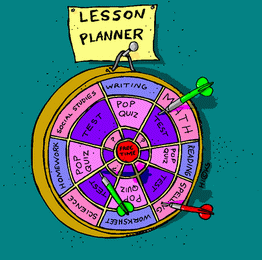
http://teachers.redclay.k12.de.us/Judith.Conway/WriteEdObj.htm Write real objectives. Make your class meaningful! Don't just throw a dart and hope for the best while lesson planning!


Unit objectives give classrooms and teachers a purpose. They act as a guideline for students and they show administrative individuals what the students will be learning and how it will be measured.

Objectives are very important because by just adding or taking away simple words, it completely changes the cognitive meaning of the objective. An example being, to list something vs explaining something that was just learned. It is much easier to list something rather than explain it since it mostly deals with memorization.
http://tech2040.pbworks.com/w/page/38193573/ABCD%20Objectives, DON'T WRITE OBJECTIVES THAT USE VAGUE VERBS. This link will bring you to a wonderful page where you can learn more about writing objectives. 

When writing unit objectives they have to go along with the different domains of learning: cognitive, psychomotor, and affective. Cognitive deals with facts, knowledge, information and concepts.This would be to relay information back to the teacher through lists, paraphrasing, and explaining. Psychomotor deals with including both mind and motor skills at the same time and has a lot of hands-on components. Affective is the hardest objective to write since it is the hardest to measure, as it deals with attitudes, values, aesthetics and appreciation (Newcomb).

In the chapter, Planning for Instruction, it suggests the following steps when writing objectives.


  1. Figure out the behavior that you want to be demonstrated/ measured
  2. The conditions under which the behavior is to occur
  3. The criteria by which the performance is judged (measured)
These steps make writing objectives more organized. They allow for creating the behavior but then actually figuring out a way to measure the behavior and control how/when the behavior is to occur. 


 It is vital for teachers to write objectives to keep the classroom flowing smoothly and for learning to occur. Learning will occur best in a low stress environment when the teacher and students are both aware of their duties and their means of accomplishing those duties.

http://fcit.usf.edu/assessment/basic/basicb.html, Base your objectives based on what behavior, conditions and criterion you want!

Monday, September 9, 2013

First Day Teaching Strategies

Perusing through the assigned reading for one of my Agricultural Education classes this semester, I read a lot about different aspects of teaching and different stages that teachers go though as they start their career, such as in the book the Effective Teacher  by Wong. According to the book, you do not even reach 'teacher' stage until you have made it to the final stage of IMPACT. In this stage the teacher makes a different in the lives of students and they " know how to open the door and invite their students to learn." This is the stage that every single teacher should strive for. If they don't try to make learning worthwhile, what is the point of teaching?

Another quote that I enjoyed from the book was "the biggest secret to teaching success - beg,borrow and steal". I liked this quote because it goes along with a commonly mentioned phrase in the Pennsylvania Agricultural Education community of "don't invent the wheel twice". I feel that the AGED community in Pennsylvania is essentially a big family, meaning teachers always try to help each other out. When there is an issue where a teacher needs a lesson plan or other resource for a subject, he or she can simply ask a colleague and will receive what they need. That is a wonderful thing to watch and also something I hope to experience in the future. 

Understanding by Design Framework, written by Jay Mctigne and Grant Wiggins, reinforced the idea that the lessons future students will learn in my classroom will be applicable to not only other classes but also in many other aspects of their life. In my advanced biology class in high school, we had to participate in a debate concerning a controversial biology topic. Afterwards, my teacher commended my speaking skills, which I credit to spending years involved in agricultural education classes and FFA. Without these critical experiences, I would still be extremely shy and unable to speak in front of others. Based on the importance of these experiences in my life, I want my students to have the same opportunities to expand their agricultural horizons and grow as a person. 

In class and in the reading Enhancing Student Learning Through Teacher Behavior by Garton, Miller and Torres, we also learned about the five behaviors that a teacher should possess, which are clarity, variability, enthusiasm, task oriented and/or business like behavior, and student opportunity to learn criterion material. Each behavior is extremely important to form the teacher-student bond necessary for success in the classroom.

I believe that if I include all that I have learned though class discussions and readings, the first day of my teaching career will be successful overall. I will survive. My goal is to make it to the final teaching stage of impact where I become a 'real' teacher. I want my students to be able to use what they learn in my classroom everywhere they go and I want to possess all the behaviors that a good teacher should have. These are my goals and I am going to work to reach them!

I found this picture on tumbler and thought that I would share it. See, in reality the teacher survives!